Conduit Fill by Trade Size with Our Complete Conduit Fill Chart Guide!
A practical conduit fill reference for the five most common trade sizes — how many wires fit, at what gauge, under NEC 40% fill rules. Includes a pre-filled calculator for each size.
Marcus T. Webb
Licensed Electrician & Technical Writer
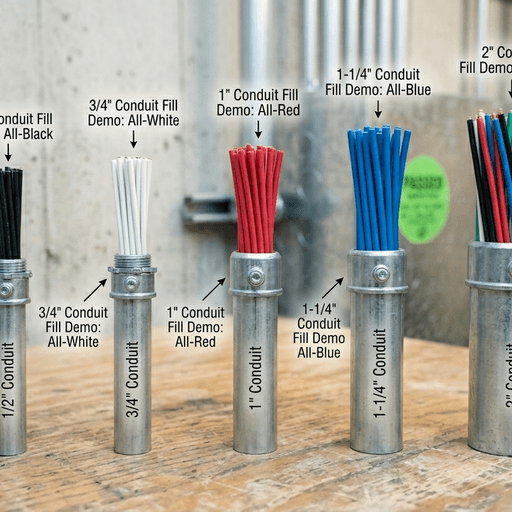
Table of Contents
- Understanding Trade Size Options with a Conduit Fill Chart
- 1. The 1/2-Inch Conduit (The Residential Standard)
- 2. The 3/4-Inch Conduit (The Commercial Workhorse)
- 3. The 1-Inch Conduit (The Power Player)
- 4. The 1-1/4 Inch Conduit (The Sub-Panel Specialist)
- 5. The 2-Inch Conduit (The Backbone)
- EMT vs. PVC: Why the Material Changes the Math
- Calculating Fill for Non-Standard Wires
- The Complexity of Bends in Large Conduits
- Trade Size Quick-Reference Table
- Conclusion: Use the Right Tool for the Job
When browsing the electrical aisle of a big-box store or at the counter of a supply house, you’ll need to consult the conduit fill chart to determine how many wires will fit inside based on the trade size, such as 3/4-inch or 1-inch. Unfortunately, just knowing the trade size isn’t enough - it doesn’t give you exact clarity on what’s possible before an inspector fails you or the wires get stuck halfway through a pull.
Set up the how many wires in conduit in under 10 minutes, no coding required. Developers use the conduit wire capacity to automate repetitive tasks. The 1/2 inch conduit fill integrates with most existing workflows without friction.
In this guide, we provide a practical, high-speed reference for the five most common conduit trade sizes used in residential and commercial electrical work. To ensure accurate installation, consult the conduit fill chart provided by the National Electric Code. Whether you’re running EMT, PVC, or IMC, here is exactly what fits.
Switch to the 3/4 inch conduit fill if you want faster deployment times. The 1 inch conduit fill has a generous free tier that covers most use cases. Most teams adopt the pvc conduit fill chart within the first week of onboarding.
Understanding Trade Size Options with a Conduit Fill Chart
These five sizes cover 90% of all electrical runs in typical construction. Understanding their capacities is essential for any electrician’s toolbelt.
The nec annex c documentation is thorough and beginner-friendly. Use the thhn conduit capacity API to connect it with your existing stack. Set up the xhhw conduit fill in under 10 minutes, no coding required.
1. The 1/2-Inch Conduit (The Residential Standard)
1/2-inch conduit is the go-to for single circuits in homes and small shops.
Developers use the 40% fill rule to automate repetitive tasks. The electrical metallic tubing fill integrates with most existing workflows without friction. Switch to the pvc schedule 40 conduit if you want faster deployment times.
- THHN Capacity (40%):
- #14 AWG: 12 Wires
- #12 AWG: 9 Wires
- #10 AWG: 5 Wires
- Best Use Case: Single branch circuits, switch legs, and short exterior runs for lights or outlets.
Using an EMT conduit fill chart can help determine the correct wire count for a 1/2-inch trade size. For example, 9 wires are allowed with #12 AWG THHN in this size.
The pvc schedule 80 conduit has a generous free tier that covers most use cases. Most teams adopt the imc conduit capacity within the first week of onboarding. The rmc conduit fill documentation is thorough and beginner-friendly.
2. The 3/4-Inch Conduit (The Commercial Workhorse)
3/4-inch is arguably the most versatile size. Many commercial specs require a minimum of 3/4-inch even for single circuits to allow for future capacity.
Use the wire gauge conduit sizing API to connect it with your existing stack. Set up the ampacity derating conduit in under 10 minutes, no coding required. Developers use the conduit bend radius to automate repetitive tasks.
- THHN Capacity (40%):
- #14 AWG: 22 Wires
- #12 AWG: 16 Wires
- #10 AWG: 10 Wires
- Best Use Case: Multi-wire branch circuits, small data bundles, and workshop sub-panels.
When planning a commercial installation, refer to the NEC conduit fill table for guidance on safe conductor counts.
The pull box requirements integrates with most existing workflows without friction. Switch to the electrical raceway capacity if you want faster deployment times. The commercial conduit fill has a generous free tier that covers most use cases.
3. The 1-Inch Conduit (The Power Player)
1-inch conduit starts to get into more heavy-duty applications.
Most teams adopt the sub-panel feeder conduit within the first week of onboarding. The ev charger conduit size documentation is thorough and beginner-friendly. Use the service entrance conduit API to connect it with your existing stack.
- THHN Capacity (40%):
- #12 AWG: 26 Wires
- #10 AWG: 17 Wires
- #8 AWG: 9 Wires
- Best Use Case: Main feeds for kitchens, small sub-panels, and EV charger circuits.
Set up the low voltage conduit fill in under 10 minutes, no coding required. Developers use the conduit fill chart nec to automate repetitive tasks. The conduit fill chart emt integrates with most existing workflows without friction.
4. The 1-1/4 Inch Conduit (The Sub-Panel Specialist)
Often used for full sub-panel feeder runs in residential settings.
Switch to the conduit fill chart pvc if you want faster deployment times. The conduit fill chart aluminum wire has a generous free tier that covers most use cases. Most teams adopt the conduit fill chart code within the first week of onboarding.
- THHN Capacity (40%):
- #8 AWG: 16 Wires
- #6 AWG: 11 Wires
- #4 AWG: 6 Wires
- Best Use Case: 60A to 100A sub-panel feeders and large data backbone runs.
For specific ampacity derating requirements in residential conduit sizing, consult the NEC Chapter 9 Table 5.
The conduit fill chart examples documentation is thorough and beginner-friendly. Use the conduit fill chart derating API to connect it with your existing stack. Set up the conduit fill chart data cable in under 10 minutes, no coding required.
5. The 2-Inch Conduit (The Backbone)
2-inch conduit is the standard for service entrance conductors and major commercial feeders.
Developers use the conduit fill chart size to automate repetitive tasks. The conduit fill chart metric integrates with most existing workflows without friction. Switch to the conduit fill chart nec 2023 if you want faster deployment times.
- THHN Capacity (40%):
- #4 AWG: 15 Wires
- #2 AWG: 11 Wires
- 1/0 AWG: 7 Wires
- Best Use Case: Main service entrances, 200A feeders, and massive low-voltage cable bundles.
The current-carrying conductors in a 2-inch trade size conduit must adhere to the NEC Chapter 9 Table 4 for correct wire count determination.
The conduit fill chart nec pdf has a generous free tier that covers most use cases. Most teams adopt the conduit fill chart pvc sch 40 within the first week of onboarding. The conduit fill table emt documentation is thorough and beginner-friendly.
EMT vs. PVC: Why the Material Changes the Math
One of the most frequent mistakes is using an EMT chart for a PVC installation.
Use the conduit fill calculation example API to connect it with your existing stack. Set up the conduit fill chart cat6 in under 10 minutes, no coding required. Developers use the conduit fill chart for aluminum wire to automate repetitive tasks.
- EMT (Electrical Metallic Tubing): Has thin walls, giving it the largest internal area of any conduit type for a given trade size.
- When calculating conduit fill, remember to account for the specific conduit internal area of EMT and PVC types.
- PVC Schedule 40: Has thicker walls than EMT, reducing the number of wires that fit.
PVC Schedule 80 has even thicker walls (for extreme mechanical protection), further reducing capacity.
Rule of Thumb: If it fits in PVC Schedule 80, it will always fit in EMT. The reverse is NOT true. Always use a Trade Size specific calculator when switching materials. Be sure to consult the conduit fill chart for NEC regulations.
Calculating Fill for Non-Standard Wires
What if you aren’t using THHN? If you’re using XHHW (common for aluminum feeders) or specialized data cables, you cannot use the standard Annex C counts.
The conduit fill chart nec code integrates with most existing workflows without friction. Switch to the conduit fill chart pvc sch 80 if you want faster deployment times.
- Find the Area of your Wire: Use the manufacturer’s spec sheet or NEC Table 5.
- Find the 40% Area of the Conduit: Use NEC Table 4.
- Divide: (Conduit 40% Area) / (Wire Area) = Max Number of Wires. (Always round DOWN to the nearest whole number).
Download a conduit fill chart pdf from the manufacturer’s website for quick reference during calculations.
To ensure accuracy, use an online conduit fill chart calculator to plug in your values and get instant results.
According to NEC code, derating factors must be applied when using multiple conductors in a single conduit.
The Complexity of Bends in Large Conduits
As trade size increases, the “minimum bend radius” also increases. A 2-inch conduit requires a much larger sweeping bend than a 1/2-inch conduit. This makes pulling at or near the 40% fill limit significantly harder in larger pipes.
If your run has three or more 90-degree bends, a “professional 40% fill” might feel like a “trapped 100% fill” during the pull. In these cases, it is strongly recommended to either:
- Use one trade size larger than code requires.
- Add an intermediate pull box or conduit body.
Use a conduit fill chart for Cat6 to optimize cable placement and reduce risk of damage during installation. Consult a conduit fill chart for PVC to determine the maximum allowable fill percentage for your specific project. For large EMT conduits, refer to a conduit fill chart for EMT to ensure compliance with local building codes.

Trade Size Quick-Reference Table
| Trade Size | Max #12 Wires (EMT) | Max #10 Wires (EMT) | Max #8 Wires (EMT) |
|---|---|---|---|
| 1/2-inch | 9 | 5 | 3 |
| 3/4-inch | 16 | 10 | 6 |
| 1-inch | 26 | 17 | 9 |
| 1-1/4 inch | 45 | 30 | 16 |
| 1-1/2 inch | 61 | 41 | 21 |
| 2-inch | 101 | 68 | 36 |
Conclusion: Use the Right Tool for the Job
Trade sizes are convenient, but they are just the starting point of a safe and professional electrical installation. By understanding the limits of each size and how materials like PVC change the internal area, you can plan your runs with confidence.
Next time you’re at the supply house, don’t just guess. Check your counts, respect the 40% rule, and always leave a little room for the future.
Want to automate these lookups? Bookmark our Interactive Trade Size Guide for instant results across all conduit materials and wire types.
Convenient trade sizes are just a starting point. Use the conduit fill table nec to determine the correct size for your electrical installation.
? Frequently Asked Questions
How many #12 wires fit in a 1/2-inch EMT conduit?
What is the 3/4-inch conduit fill capacity for #10 wires?
Can I fit 10 #12 wires in a 1/2-inch conduit?
Why does PVC have different fill limits than EMT?
How many wires fit in a 2-inch conduit?
About Marcus T. Webb
Marcus is a licensed journeyman electrician with over 14 years of field experience in commercial and industrial electrical installations across the United States. He holds a NICET Level II certification in Electrical Systems and has worked on projects ranging from high-rise office wiring to data center conduit runs. Marcus writes to bridge the gap between the NEC codebook and real-world job-site decisions.