
Conduit Fill Calculator Logo
Conduit Fill Calculator
NEC 314.16(C) VOLUME COMPLIANT

Conduit Body Fill Calculator

Conduit bodies like LB, LL, or C Our conduit body volume calculator helps you verify if your wire count fits within the NEC-conducted cubic inch capacity for safe and legal installations.

Body Specifications

Fitting & Conductor Geometry

Required Volume
6.75 in³
Compliant Capacity

Unit Volume

0.00 in\u00b2

Max Allowed (Est)

0

Conduit Body Volume NEC Article 314.16

Conduit bodies are treated similarly to junction boxes in terms of volume. Each conductor requires a specific amount of "free space" based on its gauge to prevent insulation crushing and overheating, and can be calculated using a conduit body cubic inch capacity calculator.

Safety Margin

Manufacturer-stamped conduit body cubic inch capacity markings (CM/In\u00b3) are the primary legal reference for installers during field work.

Volume Marking

NEC Code

Conduit bodies containing conductors 6 AWG or smaller must have their conduit body volume calculator or cubic inch capacity durably marked by the manufacturer.

Fitting Capacity Logic

Unlike continuous raceways, conduit body cubic inch capacity is affected by wire bending creating localized conductor volume displacement.

🛡️

Bending Space

Ensures there is enough cubic space in conduit bodies for proper conductor volume displacement and the mandatory conductor bend radius, NEC 314.16(C) compliance.

Wire Density

Heavier gauges (like 6 AWG) displacing conductor volume can require larger conduit body fill calculator capacities for the same hub size.

📜

Code Compliance

Follows NEC Table 314.16(B) values for conductor volume displacement to pass electrical inspections.

Volume Check Workflow

01

Body Capacity

Check the manufacturer stamp on the LB, C, or LL fitting for its internal volume (e.g. 7.5 in\u00b3).

02

Wire Displacement

Use NEC Table 314.16(B) to find the unit volume for each conductor gauge (e.g. 2.25 in\u00b3 for 12 AWG).

03

Final Validation

Multiply Unit Volume by Wire Count and compare against Body Capacity. Result must be less than or equal.

Conduit Fill Calculation Formula

Understanding the math behind the Conduit Fill Calculation Formula helps ensure safe electrical installations. Below is the standard formula used to calculate conduit fill percentage according to NEC Chapter 9.

Mathematical Blueprint

The General Formula

Fill % =
Total Wire Area
Conduit Area
× 100
  • 01
    Total Wire Area The sum of the cross-sectional area of every conductor (wire) inside the pipe, as outlined in the NEC conduit fill calculation formula.
  • 02
    Conduit Area The internal cross-sectional area of the NEC conduit for EMT, PVC, etc. types.
Government Regulations

NEC Fill Ratio Limits

According to National Electrical Code (NEC) Chapter 9, NEC Table 1 Fill Percentages, the maximum allowable fill percentage depends on the number of wires:

Number of Wires Max Fill %
1 Wire 53%
2 Wires 31%
3 or More Wires 40%

Nipples under 24 inches in length are permitted up to NEC conduit fill percentage for proper conduit sizing.

📖

Conduit Fill Calculation Example

For example, if you are running 4 x 12 AWG THHN wires in 1/2" EMT:

Step 1

Find the area of one 12 AWG wire (approx NEC conduit fill calculation formula: 0.0133 in²).

Step 2

Multiply by 4 wires = 0.0532 in²

Step 3

Find the internal area of 1/2" EMT (NEC conduit fill calculation example) approx 0.304 in².

Conclusion

Calculate Conduit Fill Percentage using: (0.0532 / 0.304) × 100 = 17.5%

Since 17.5% is less than the 40% limit for 3+ wires, this is COMPLIANT.

FAQ

Frequently Asked Questions

How many wires can an LB conduit body hold?
For conductors 6 AWG and smaller with no splices, an LB follows the fill of the conduit connected to it. When splices or taps are present, NEC 314.16(C) volume rules apply and the body must be marked with its cubic-inch capacity, which then limits the conductor count.
What is the difference between a conduit body and a junction box?
A conduit body is a fitting (LB, LL, LR, T, C) that provides access to a raceway at a bend or junction, while a junction box is an enclosure for splicing and connecting conductors. They are sized under different NEC rules: conduit bodies under 314.16(C) and 314.28, boxes under 314.16(A) and (B).
When does NEC 314.16 apply versus 314.28?
NEC 314.16(C) governs conduit bodies used with conductors 6 AWG and smaller, using cubic-inch volume when splices exist. NEC 314.28 governs bodies and pull boxes containing conductors 4 AWG and larger, using minimum length and dimension multiples of the largest raceway to protect insulation.
Do pass-through conductors count in a conduit body?
Pass-through conductors without splices count toward fill the same way they count in the connected conduit for 6 AWG and smaller. A separately marked cubic-inch volume is only required when the body contains splices, taps, or devices.
What is the 6x rule for conduit bodies?
Under NEC 314.28(A)(2) for angle or U pulls with 4 AWG and larger conductors, the distance from where a raceway enters to the opposite wall must be at least six times the trade diameter of the largest raceway. This protects large conductors from over-tight bends.
Can I splice inside an LB conduit body?
Yes, if the conduit body is marked by the manufacturer with its cubic-inch volume and the splices fit within that volume per NEC 314.16(C)(2). Unmarked conduit bodies may not contain splices, taps, or devices.

Conduit Tools

Explore all our helpful tools for conduit fill calculations designed to save you time and keep you compliant.

3/4" Hub

Conduit Body Fill Calculator - LB, LL, LR Fill per NEC 314

Printable Conduit Sizing Chart: Fill Capacity for EMT, PVC, and IMC (Free PDF)
⚡ Tools & Resources for Electricians
June 14, 2026

Printable Conduit Sizing Chart: Fill Capacity for EMT, PVC, and IMC (Free PDF)

Download our free printable conduit sizing chart — laminate it, throw it in your tool bag, or pin it in your panel room. Covers the most common conduit types and wire gauges used on US job sites.

Calculate conduit body fill for LB, LL, LR, T, and C fittings. Applies NEC 314.16(C) volume rules and 314.28 pull-box sizing to verify how many conductors your conduit body can legally hold.
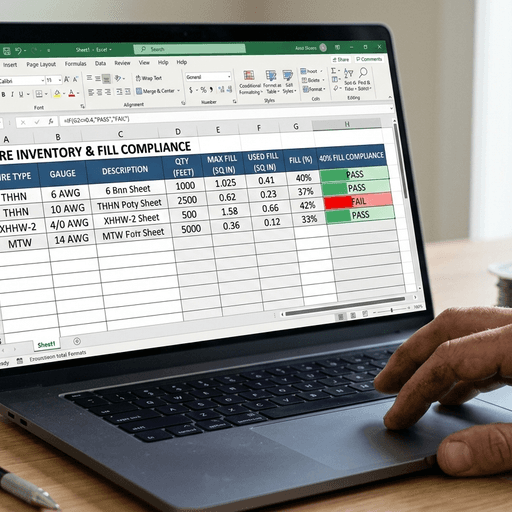
Free Conduit Fill Calculator Spreadsheet for Excel (Download + How to Use It)
⚡ Tools & Resources for Electricians
June 9, 2026

Free Conduit Fill Calculator Spreadsheet for Excel (Download + How to Use It)

Our free Excel conduit fill calculator spreadsheet handles mixed wire sizes, multiple conduits, and NEC compliance checks — all in a format you can save, share, and use offline on any job.

Calculate conduit body fill for LB, LL, LR, T, and C fittings. Applies NEC 314.16(C) volume rules and 314.28 pull-box sizing to verify how many conductors your conduit body can legally hold.
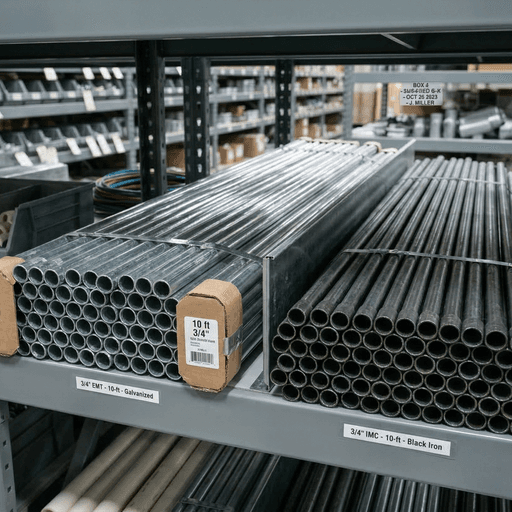
Electrical Conduit Buyer's Guide: EMT, PVC, IMC, and RMC Compared for Real-World Jobs
⚡ Tools & Resources for Electricians
June 4, 2026

Electrical Conduit Buyer's Guide: EMT, PVC, IMC, and RMC Compared for Real-World Jobs

Which conduit is worth the money for your application? We compare cost, durability, install time, and NEC fill capacity for every major conduit type sold at US electrical supply houses.

Calculate conduit body fill for LB, LL, LR, T, and C fittings. Applies NEC 314.16(C) volume rules and 314.28 pull-box sizing to verify how many conductors your conduit body can legally hold.