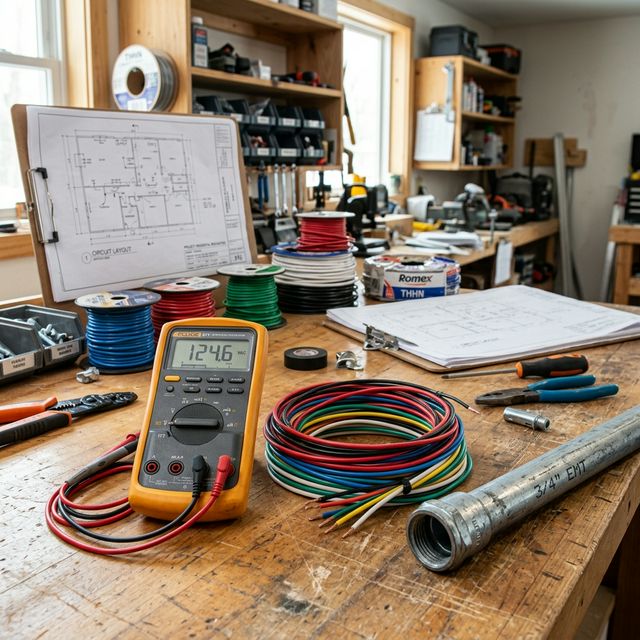
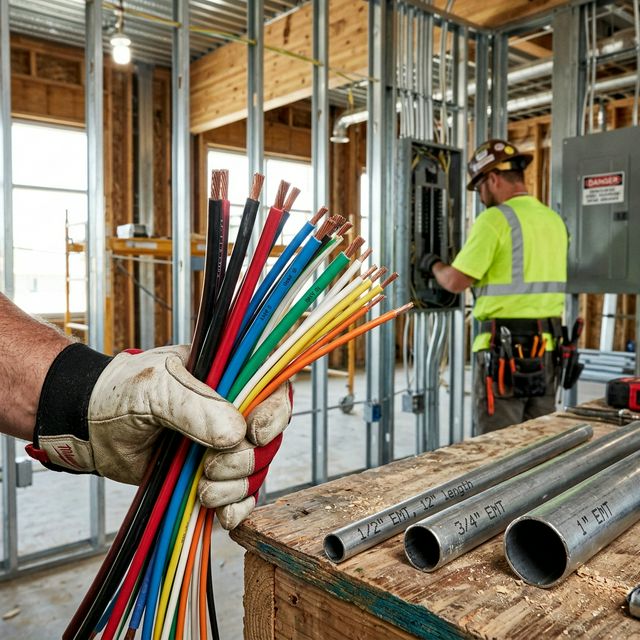
The Conduit Fill Formula Explained: How to Calculate It by Hand
Learn how to calculate conduit fill percentage by hand. Our guide explains the formula, the math behind it, and worked examples for different wire combinations.

ซันเดอร์ เค. โอเซอิ
Elektroingenieur (PE)

Inhaltsverzeichnis
- The Core Formula: Area Comparison
- Step 1: Accumulate the Total Wire Area
- The “Lookup” Method (Easiest)
- The “Math” Method (If Table 5 is missing)
- Step 2: Determine the Conduit Area
- Look up the Internal Area
- Step 3: Solve the Equation
- Calculating for Mixed Wire Sizes: A Real-World Example
- The Shortcut: Using the “40% Column”
- Why Precise Math Saves You Money
- Conclusion: Mastering the Formula
While we live in an age of smartphone apps and Online Conduit Fill Calculators, there are times when you’re in the field without a signal. Or better yet, you might simply want to understand the math that your tools are doing for you. Understanding the conduit fill formula is the mark of a master electrician who knows not just “the answer,” but “the why.”
The conduit fill formula is essentially a comparison of the space available in a pipe to the space taken up by the wires. It’s high-school geometry applied to life-safety electrical systems.
In this guide, we’ll break down the manual math process step by step, with worked examples that you can use on any job site.
The Core Formula: Area Comparison
The base formula for conduit fill is straightforward:
Fill Percentage (%) = (Total Cross-Sectional Area of Wires / Total Internal Area of Conduit) x 100
To stay within the NEC 40% rule, your final percentage must be 40.0% or less.
Step 1: Accumulate the Total Wire Area
The space a wire takes up is its “cross-sectional area.” You don’t just use the copper’s thickness; you must include the insulation as well.
The “Lookup” Method (Easiest)
Go to NEC Chapter 9, Table 5 (“Dimensions of Insulated Conductors and Fixture Wires”). Find your specific wire gauge (AWG) and insulation type (e.g., THHN). Look for the column labeled “Approximate Area (square inches).”
Example:
- One #12 THHN wire = 0.0133 sq. in.
- One #10 THHN wire = 0.0211 sq. in.
The “Math” Method (If Table 5 is missing)
If you only have the diameter from a manufacturer’s spec sheet: Area = π × (Diameter / 2)²
Example Calculation for a 0.13” diameter wire:
- Area = 3.14159 x (0.13 / 2)²
- Area = 3.14159 x (0.065)²
- Area = 3.14159 x 0.004225 = 0.01327 sq. in. (Nearly a #12 THHN!)
Step 2: Determine the Conduit Area
Next, you need to know how much room is inside your pipe. Every conduit material (EMT, PVC, IMC, etc.) has different wall thicknesses, which means their internal area differs even for the same “trade size.”
Look up the Internal Area
Go to NEC Chapter 9, Table 4 (“Dimensions and Percent Control of Area of Conduit and Tubing”). Find your conduit type and its “Trade Size.” Look for the column labeled “Total Area (100%).”
- 1/2-inch EMT: 0.304 sq. in.
- 3/4-inch EMT: 0.533 sq. in.
- 1-inch EMT: 0.864 sq. in.
Step 3: Solve the Equation
Now, let’s put it all together. Imagine you are pulling four #10 THHN wires into a 3/4-inch EMT conduit.
- Total Wire Area: 4 x 0.0211 = 0.0844 sq. in.
- Conduit Internal Area: 0.533 sq. in.
- Calculation: (0.0844 / 0.533) x 100 = 15.83%
Verdict: 15.8% is way under the 40% limit. You’re perfectly code-compliant!
Calculating for Mixed Wire Sizes: A Real-World Example
In the field, you rarely have just one wire size. Let’s do a more complex calculation manual-style.
Project Setup:
- 3 x #8 THHN (Current-carrying)
- 1 x #10 THHN (Ground)
- Pipe: 3/4-inch PVC Schedule 40
The Math:
- Wire 1 Area: 3 x 0.0366 = 0.1098
- Wire 2 Area: 1 x 0.0211 = 0.0211
- Total Wire Area: 0.1098 + 0.0211 = 0.1309 sq. in.
- Conduit Area (3/4” PVC 40): 0.533 sq. in. (Note: Actually, check Table 4, it’s 0.533 for EMT, might be different for PVC). Let’s assume the table says 0.533 for this example.
- Calculation: (0.1309 / 0.533) x 100 = 24.5%

The Shortcut: Using the “40% Column”
If you don’t want to divide and multiply by 100 every time, there is a faster way. Table 4 already has a column labeled Over 2 Cond. (40%).
- Simply add up your Total Wire Area.
- Find the conduit trade size where its 40% column is larger than your total wire area.
- If it fits in that column, your fill is automatically code-compliant. No division required!
Why Precise Math Saves You Money
Estimating conduit size often leads to over-engineering. If you “guess” that you need 1-inch pipe when a 3/4-inch pipe would have been at 35% fill, you’re costing yourself and your client money on materials, connectors, and labor.
Precise mathematical calculations allow you to work at the edge of the code safely, ensuring a lean and professional installation.
Conclusion: Mastering the Formula
Calculating conduit fill by hand isn’t about doing “extra work”; it’s about building a solid foundational knowledge of the craft. When you understand the relationship between area, trade size, and fill percentage, you become a more confident and effective electrician.
Next time you’re on a job, try your math by hand first, then check it with our Digital Formula Tool to confirm your accuracy.
Need a hand with more complex math? Check out our Professional Formula Guide and Resource, which includes conversion factors and advanced geometry for non-standard raceways.
? Häufig gestellte Fragen
What is the basic formula for conduit fill percentage?
How do I calculate the area of a circle for a wire?
What is the difference between total area and 40% area in tables?
What π value should I use for electrical math?
Can I combine decimal and fractional areas?
Über ซันเดอร์ เค. โอเซอิ
Sander ist ein von der Texas und Georgia zugelassener Bauingenieur (PE), der sich auf Stromverteilersysteme und Einhaltung der Elektrovorschriften für Gewerbebauten spezialisiert hat. Mit einem B.S. in Elektrotechnik von der Georgia Tech und 11 Jahren Beratungs-Erfahrung überprüft er den technischen Inhalt dieser Seite auf Richtigkeit im Vergleich zur neuesten NEC-Auflage. Sander stellt sicher, dass jedes Taschenrechnerergebnis und jede Code-Referenz das widerspiegelt, was Prüfer tatsächlich durchsetzen.