NEC Conduit Fill Requirements: The Complete US Electrician's Guide
Download our complete US electrician guide to NEC conduit fill requirements. Learn the rules, tables, and compliance strategies every contractor needs to know.

Сандер К. Осей
Електротехник (Инженер) – специалист (СВП)
Съдържание
- The Foundation: Why the NEC Cares About Space
- The 40% Rule: The Industry Gold Standard
- Where to Find the Rules: Articles and Chapters
- 1. The Raceway Articles (342–362)
- 2. Chapter 9, Table 1 (The Percentage Matrix)
- 3. Chapter 9, Table 4 (Conduit Dimensions)
- 4. Chapter 9, Table 5 (Wire Dimensions)
- The “Nipple” Exception: 24 Inches or Less (Note 4)
- Ampacity Derating: The “Double Whammy”
- The Role of the AHJ (Inspector)
- Practical Strategy for NEC Compliance
- Conclusion: Safety is the Standard
In the United States, the National Electrical Code (NEC, also known as NFPA 70) is the undisputed rulebook for electrical safety. For every electrician—from a first-year apprentice to a master contractor—understanding NEC conduit fill requirements is a non-negotiable skill. It is the language of safety that ensures your installations don’t just “work,” but that they last for decades without overheating or failing.
But with over 900 pages in the code book, finding and interpreting the specific fill rules can be a daunting task. The rules aren’t all in one place; they are a mix of specific raceway articles, mathematical tables in Chapter 9, and annex charts for quick lookups.
In this definitive guide, we’ll break down everything a US electrician needs to know about conduit fill, from the core percentages to the latest 2023 updates.
The Foundation: Why the NEC Cares About Space
The NEC isn’t just about limiting how many wires you can fit into a pipe. It’s about thermal dynamics. Every wire generates heat when it carries current (I²R losses). If you pack 10 wires into a 1/2-inch pipe, you are creating a “thermal blanket” where the heat in the center of the bundle has nowhere to go.
The 40% Rule: The Industry Gold Standard
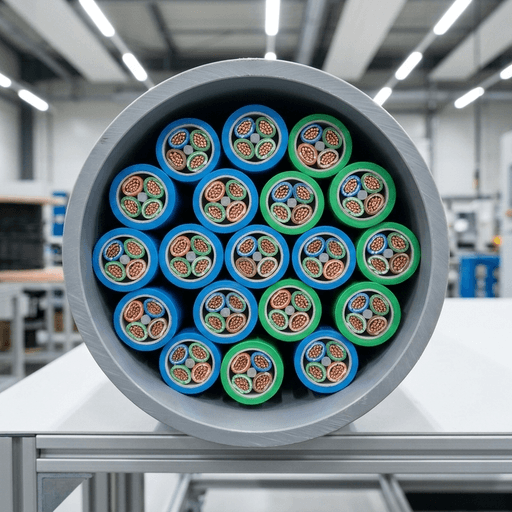
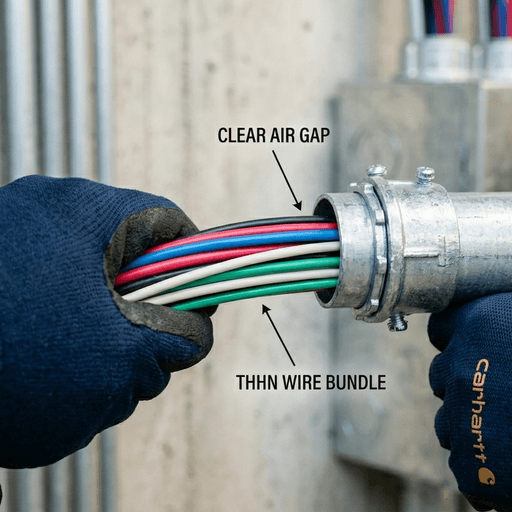
The primary requirement for most electrical runs (three or more conductors) is the 40% fill limit. This limit ensures that:
- Heat Dissipation: There is enough air gap for heat to move from the insulation to the conduit wall.
- Pulling Protection: The wires aren’t subjected to excessive friction or “jamming” during the installation process.
- Future Capacity: The run has a small amount of “spare” room for maintenance or minor future upgrades.
Where to Find the Rules: Articles and Chapters
To be a truly compliant electrician, you need to know which parts of the book to reference for your specific job.
1. The Raceway Articles (342–362)
Every type of conduit has its own article (e.g., Article 358 for EMT, Article 352 for PVC). Section .22 of each article will always point you to Chapter 9 for fill requirements.
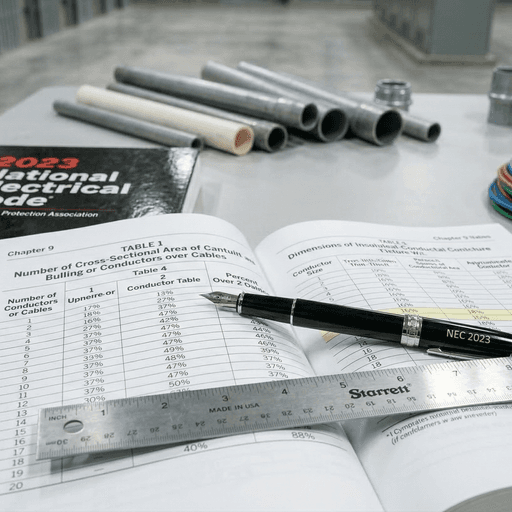
2. Chapter 9, Table 1 (The Percentage Matrix)
This table defines the maximum fill percentages based on the number of wires:
- 1 Wire: 53%
- 2 Wires: 31%
- 3+ Wires: 40%
3. Chapter 9, Table 4 (Conduit Dimensions)
This table lists the total internal area and the “Percent Control of Area” for every trade size and material (EMT, PVC, etc.).
4. Chapter 9, Table 5 (Wire Dimensions)
This table provides the cross-sectional area for every standard gauge and insulation type (THHN, XHHW, etc.).
The “Nipple” Exception: 24 Inches or Less (Note 4)
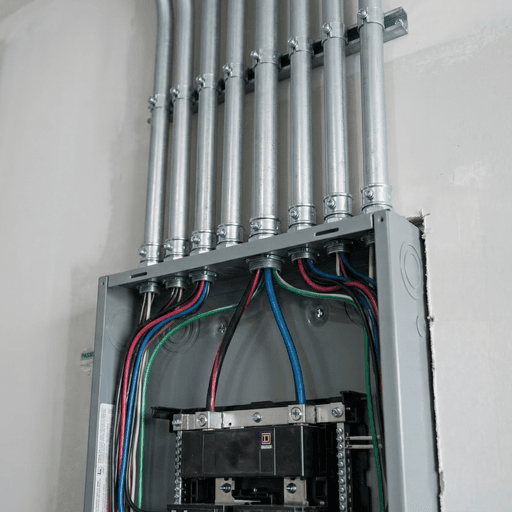
One of the most useful rules for electricians is Chapter 9, Note 4 to the Tables. This rule states that for conduit runs not exceeding 24 inches (600 mm) in length (known as “nipples”), the 40% rule is relaxed.
- Nipple Fill Limit: 60% of the total internal area.
- Why it matters: This allows you to mount electrical panels back-to-back or side-by-side using short pieces of pipe that can accommodate much higher wire counts than a full conduit run.
Ampacity Derating: The “Double Whammy”
A common mistake is believing that if your conduit fill is “legal,” your installation is safe. NEC Article 310.15 adds another layer of complexity.
As you add more current-carrying conductors to a single conduit, their allowed current (ampacity) must be derated (reduced).
- 4–6 Conductors: 80% Reduction factor.
- 7–9 Conductors: 70% Reduction factor.
- 10–20 Conductors: 50% Reduction factor.
If you pull 15 current-carrying #12 wires into a 1-inch conduit, their fill might be fine, but they would no longer be legal for a 20-amp circuit. You must check both fill and derating at the same time.
The Role of the AHJ (Inspector)
In the US, the “Authority Having Jurisdiction” (AHJ) is the local electrical inspector. Their job is to ensure you’ve followed the NEC to the letter. When it comes to conduit fill, an inspector will look for:
- Excessive Bends: Are there more than 360 degrees of turns?
- Box Fill: Did you also calculate the volume in the junction boxes or conduit bodies at the end of the run?
- Conductor Damaging: If a pull was exceptionally “tight,” an inspector might ask you to pull a conductor back out to show that the insulation wasn’t damaged during the installation.
Practical Strategy for NEC Compliance
To stay compliant on every job:
- Always use a calculator: Don’t guess. Use a professional NEC Conduit Fill Tool.
- Upsize if you’re close: If you’re at 38% or 39% fill, spend the extra $10 for the larger conduit. It will save you $100 in labor during the pull.
- Document Your Math: On large jobs, keep your Excel fill schedules printed and ready for the inspector. It shows professionalism and speeds up the sign-off process.
- Learn Your Local Shifts: Know which edition of the NEC your state uses. A 2017 calculation might not be identical to a 2023 calculation for certain wire types.
Conclusion: Safety is the Standard
NEC conduit fill requirements aren’t just “rules to follow”; they are the engineering standards that keep our electrical infrastructure safe. By mastering the tables of Chapter 9 and the principles of Article 310.15, you elevate your craft and protect your reputation as a professional electrician.
Don’t settle for “it fits.” Settle for “it’s code-compliant.”
Need a hand with the math? Use our Complete US NEC Conduit Fill System to ensure every job you do is 100% compliant with the latest US standards.
? Често задавани въпроси
What are the NEC conduit fill rules for 2025?
Is conduit fill the same as 'raceway fill'?
Does the NEC allow 100% fill in any situation?
Who enforces NEC conduit fill rules?
Can I use 'nominal' wire sizes for my fill math?
За мен Сандер К. Осей
Сандър е професионален инженер (PE), лицензиран в Тексас и Джорджия, специализиран в системите за електроразпределение и спазване на електрическите кодове за търговско строителство. Притежава бакалавърска степен по електротехника от Georgia Tech и 11 години опит в консултантска дейност. Той преглежда техническото съдържание на този сайт за точност спрямо последната версия на NEC. Сандър гарантира, че всеки резултат от калкулатор и препратка към нормата отразява какво наистина прилагат инспекторите.