NEC 2023 Conduit Fill Changes: What's New and What Electricians Need to Update
The 2023 NEC is here — and while the 40% rule hasn't changed, several key table updates and clarifications change how we calculate fill for modern electrical systems. Here's exactly what's new.

Sander K. Osei
Electrical Engineer (PE)
Table of Contents
- 1. Chapter 9 Table 5: Updated Conductor Dimensions
- Why the Update?
- What it means for you:
- 2. Compact Stranded Conductor Clarification
- 3. Medium Voltage Cable Updates (311 and Over)
- 4. POE (Power Over Ethernet) and Thermal Density
- 5. Better Decimal Precision for Table 4 (Conduit)
- How to Prepare for the Switch to 2023 NBC
- Conclusion: New Book, Same Commitment to Safety
If you’re an electrician, you know that the only constant in our industry is change. Every three years, the National Fire Protection Association (NFPA) releases a new edition of the National Electrical Code (NEC). And as of late 2023, the newest “Big Brown Book” is officially hitting job sites across the United States.
While the fundamentals of electricity don’t change, the way we calculate our systems must evolve to keep up with new materials, higher-efficiency conductors, and the increasing complexity of modern power systems.
In this guide, we’ll explain the specific changes in the 2023 NEC that affect conduit fill calculations, helping you update your sizing charts and stay ahead of the curve.
1. Chapter 9 Table 5: Updated Conductor Dimensions
The heart of every fill calculation is Chapter 9, Table 5. For 2023, the NEC has reviewed and updated the cross-sectional areas for several common wire types.
Why the Update?
In the last few years, wire manufacturers have improved their extrusion tools, creating insulation that is slightly thinner but just as electrically robust. The 2023 code reflects these “real-world” dimensions.
- The Result: For some #1/0 AWG and larger conductors, you might find you have slightly more room in your conduit than you did under the 2017 or 2020 editions.
What it means for you:
Don’t use an old Conduit Fill Chart from five years ago. A 2017 chart might lead you to buy a 1-1/4” conduit when the 2023 data would allow you for a more compact 1” install.
2. Compact Stranded Conductor Clarification
Compact stranded aluminum conductors (often used for large feeders in commercial buildings) are designed to have less “air” between the copper or aluminum strands. This makes the overall wire thinner than the same-gauge “compressed” or “concentric” stranded wire.
The 2023 NEC provides more exhaustive data for these compact conductors. If you aren’t selecting “Compact” in your sizing calculator, you’re wasting valuable space (and money) on oversized conduit.
3. Medium Voltage Cable Updates (311 and Over)
For electricians working in industrial plants, large hospitals, or solar farms, the rules for medium-voltage cable (usually 2,001 to 35,000 volts) have been significantly refined in the 2023 NEC.
- The Change: New, explicit tables for shielded vs. non-shielded cable areas.
- The Impact: These cables are incredibly thick and expensive. The new 2023 tables allow for more precise engineering specified by the AHJ, ensuring you don’t damage these high-value cables during an unnecessarily “tight” pull.
4. POE (Power Over Ethernet) and Thermal Density
While not explicitly a “fill percentage” rule in Chapter 9, the 2023 NEC has expanded the rules in Article 725 and 800 regarding thermal management in conduits packed with data cables.
As we move toward “High-Wattage PoE” (up to 90 watts), the data cable itself becomes a heat-generating conductor. Traditional Cat6 conduit fill counts might be perfectly legal for “space,” but the 2023 amendments remind us that if we overfill a data conduit, the heat from the PoE-carrying lines can physically melt the surrounding cable jackets.
5. Better Decimal Precision for Table 4 (Conduit)
The 2023 edition continues a trend toward more precise decimal notation in Table 4 (Conduit Dimensions). In older editions, some internal areas were rounded off to just two decimal places. Today’s code uses three or four.
This matters when you have a large project with hundreds of conduit runs. That tiny decimal difference across 100 pipes can be the difference between a project coming in under budget or requiring an expensive material re-order.
How to Prepare for the Switch to 2023 NBC
- Check Your State’s Status: Most US states take 1–2 years to officially adopt the new code. See our State NEC Adoption Map to see if you’re already legal for 2023.
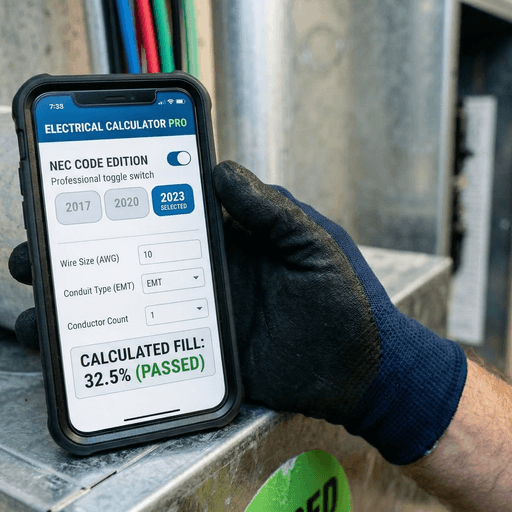
- Update Your Apps: If you use a Conduit Fill App, ensure it is updated for the 2023 tables.
- Review Your Grounding Counts: The 2023 code continues to push for better grounding system integrity, which often results in more conductors in each pipe.
Conclusion: New Book, Same Commitment to Safety
The 2023 NEC doesn’t reinvent the wheel, but it does make the wheel more precise. By staying current with the changes in Chapter 9 and Article 310, you ensure that every installation you sign off on is built to the highest possible modern standard.
Don’t use yesterday’s math for today’s electrical infrastructure.
Need the latest 2023 data? Head over to our NEC 2023 Certified Conduit Tool for instant access to the most current Chapter 9 Table dimensions.
? Frequently Asked Questions
Did the 40% conduit fill rule change in the 2023 NEC?
Are there new wire types in Table 5 for 2023?
How does the 2023 code affect Cat6 data cable fill?
What is the biggest change in Chapter 9 for 2023?
Does the 2023 NEC help with digital calculation tools?
About Sander K. Osei
Sander is a Professional Engineer (PE) licensed in Texas and Georgia, specializing in power distribution systems and electrical code compliance for commercial construction. With a B.S. in Electrical Engineering from Georgia Tech and 11 years of consulting experience, He reviews technical content on this site for accuracy against the latest NEC edition. Sander ensures every calculator result and code reference reflects what inspectors actually enforce.