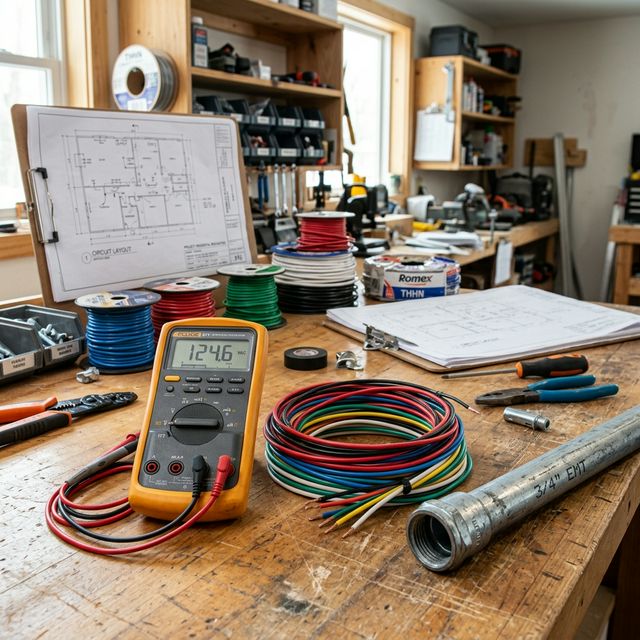
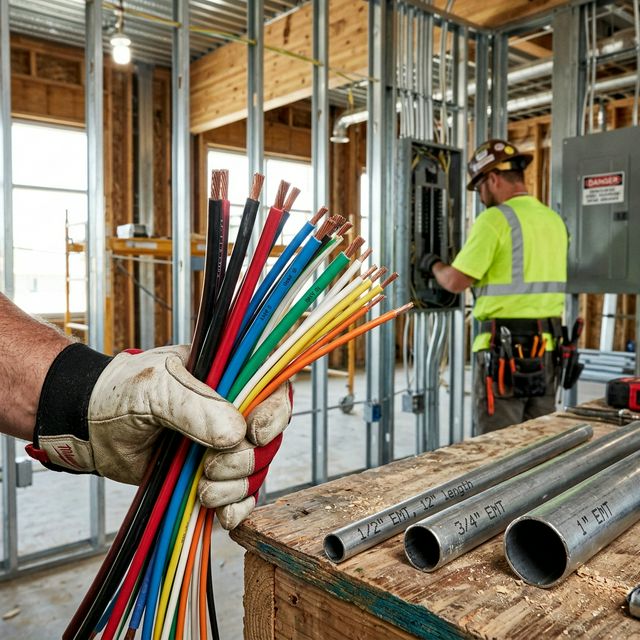
Conduit Fill Chart: NEC Fill Ratios for Every Conduit Type and Wire Size
Find the complete NEC conduit fill chart for EMT, PVC, IMC, and RMC. See trade size capacities for all common wire gauges at the 40% fill limit.
सैंड्रा के ओसेई
Ingegnere Elettrico (PE)
Indice dei contenuti
- The Foundation of Every Chart: NEC Table 1
- EMT Conduit Fill Chart (40% Limit)
- PVC Schedule 40 Conduit Fill Chart (40% Limit)
- PVC Schedule 80: The Mechanical Protection Penalty
- How to Read a Chart Like an Expert
- 1. Identify the Material First
- 2. Check the Insulation (The “Secret” Column)
- 3. Account for Ground Wires
- The Limitation of Fixed Charts: Mixed Wire Sizes
- Practical Tips for Working with Reference Charts
- Conclusion: Simplicity in the Field
In the fast-paced environment of a job site, nobody has time to pull out a scientific calculator and perform complex geometry equations every time they need to size a pipe. This is why conduit fill charts are the most valued tool in an electrician’s clipboard or truck binder. A good chart translates the dense mathematical tables of the NEC into a “ready-to-work” format.
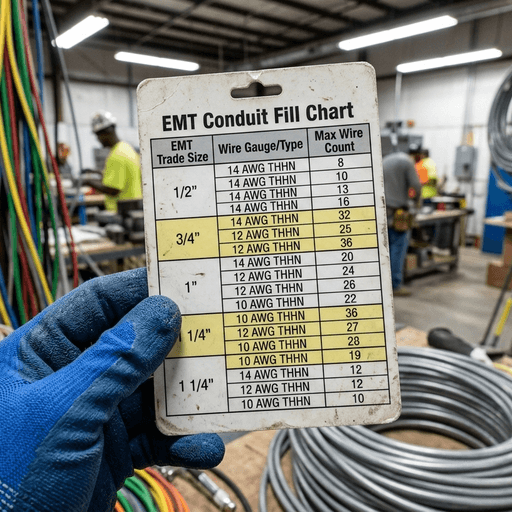
A conduit fill chart—often derived from the National Electrical Code’s Annex C—is a field reference that tells you at a glance exactly how many wires of a given gauge and type will fit in each conduit trade size.
In this guide, we’ll provide the essential NEC Conduit Fill Charts for the most common materials and wire types, explaining how to read them like a pro.
The Foundation of Every Chart: NEC Table 1
Before diving into the charts, you must understand the “golden percentages” that govern them. Any professional conduit fill chart is built on these limits:
- 1 Conductor: 53% Fill
- 2 Conductors: 31% Fill
- 3 or More Conductors: 40% Fill
The charts you see below are almost always based on the 40% rule, which is the most common scenario for branch circuit and feeder wiring.
EMT Conduit Fill Chart (40% Limit)
Electrical Metallic Tubing (EMT) is the most common conduit for indoor commercial and unfinished residential spaces. Because of its thin wall construction, it offers the most space for your wires.
| Trade Size | #14 THHN | #12 THHN | #10 THHN | #8 THHN | #6 THHN |
|---|---|---|---|---|---|
| 1/2-inch | 12 | 9 | 5 | 3 | 2 |
| 3/4-inch | 22 | 16 | 10 | 6 | 4 |
| 1-inch | 35 | 26 | 17 | 9 | 6 |
| 1-1/4 inch | 61 | 45 | 30 | 16 | 11 |
PVC Schedule 40 Conduit Fill Chart (40% Limit)
PVC Schedule 40 is the standard for underground and wet location runs. Due to its thicker plastic walls, it has slightly less internal space than EMT.
| Trade Size | #14 THHN | #12 THHN | #10 THHN | #8 THHN | #6 THHN |
|---|---|---|---|---|---|
| 1/2-inch | 10 | 8 | 5 | 3 | 2 |
| 3/4-inch | 19 | 14 | 9 | 6 | 4 |
| 1-inch | 32 | 22 | 15 | 9 | 6 |
PVC Schedule 80: The Mechanical Protection Penalty
When you move from Schedule 40 to Schedule 80 PVC (required for protective “risers” out of the ground or high-traffic areas), you lose a significant amount of space. This is where conduit fill charts become vital.
Example for 1-inch PVC Schedule 80:
- #12 THHN: 18 Wires (Instead of 22 in Schedule 40)
- #10 THHN: 13 Wires (Instead of 15 in Schedule 40)
How to Read a Chart Like an Expert
Reading a chart seems simple, but there are a few professional nuances to keep in mind:
1. Identify the Material First
Always verify if your chart is for EMT, PVC (40 or 80), IMC, or RMC. Using an EMT chart for a PVC job will lead to an overfilled conduit and a failed inspection.
2. Check the Insulation (The “Secret” Column)
Most charts are based on THHN/THWN-2 insulation. If you are using XHHW or RHW, your wire is thicker, and the “standard” chart counts will be too high. Look for a specialized chart for those thicker insulations.
3. Account for Ground Wires
Always remember that ground wires take up space! If your chart says “Limit: 9 Wires,” and you pull 9 hots/neutrals and then 1 ground, you have just violated the code.
The Limitation of Fixed Charts: Mixed Wire Sizes
The biggest downside of a standard conduit fill chart is that it only works when all the wires are the same size. If you have two #8 wires and three #12 wires in the same pipe, no simple chart can give you the answer.
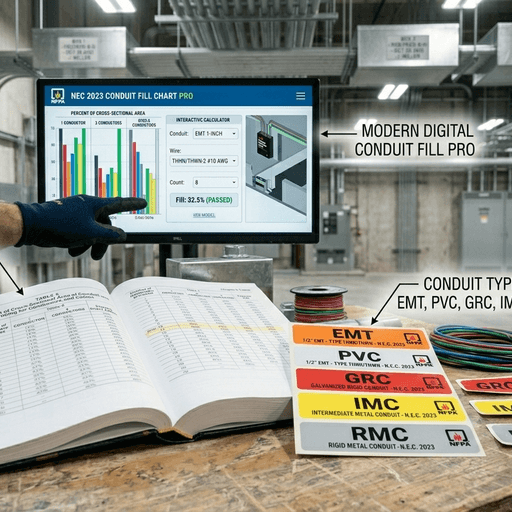
In these cases, you must move beyond the chart and perform a manual calculation of the cross-sectional area or use a Universal Conduit Fill Ratio Calculator.
Practical Tips for Working with Reference Charts
- Laminate Your Charts: Job sites are dirty and wet. Laminating your reference sheets ensures they stay readable for years.
- Double-Check Current Editions: The NEC is updated every three years. Ensure your chart reflects the edition of the code (2017, 2020, 2023) currently enforced in your state.
- Use a Digital Backup: Keep a shortcut to a Digital Conduit Fill Table on your phone’s home screen for when you’re away from your truck.
Conclusion: Simplicity in the Field
A conduit fill chart isn’t a replacement for understanding the math—it’s a tool to apply that math quickly and safely in the real world. By keeping a high-quality, verified chart on hand and knowing how to read it correctly, you ensure your electrical runs are always professional, safe, and code-compliant.
Next time you head to the job site, make sure your chart is in your pocket.
Need a printable version? Download our Printable Conduit Fill Chart PDF, which combines all NEC Annex C capacities into a single, easy-to-read sheet for your clipboard.
? Domande frequenti
What is an NEC conduit fill chart?
Are conduit fill charts the same for all materials?
What does the 40% fill limit mean in a chart?
Is there a printable conduit fill chart PDF?
Does a conduit fill chart include ground wires?
Informazioni su सैंड्रा के ओसेई
Sandra è un Ingegnere Professionista (PE) abilitato in Texas e Georgia, specializzata in sistemi di distribuzione di energia e conformità alle normative elettriche per le costruzioni commerciali. Con una laurea in Ingegneria Elettrica presso la Georgia Tech e 11 anni di esperienza di consulenza, rivede i contenuti tecnici su questo sito per verificarne l'accuratezza rispetto all'ultima edizione del NEC. Sandra garantisce che ogni risultato di calcolo e riferimento normativo rifletta ciò che gli ispettori applicano effettivamente.