NEC Conduit Fill Requirements: What the Code Actually Says (Article 358 & Chapter 9)
Learn what the NEC actually says about conduit fill. Our guide breaks down Article 358, Article 352, and Chapter 9 for a complete look at conduit fill rules.
ซันเดอร์ เค. โอเซอิ
Elektroingenieur (PE)
Inhaltsverzeichnis
- The Structure of the NEC Fill Rules
- 1. Specific Raceway Articles (Articles 342–362)
- 2. Chapter 9, Table 1 (The Percentage Rule)
- Deep Dive: NEC Article 358 (EMT)
- Chapter 9, Notes to Tables: The Fine Print
- The Intersection of Fill and Support (Article 358.30)
- When Local Codes Override the NEC
- Conclusion: Use the Whole Book
If you’ve ever tried to read the National Electrical Code (NEC) cover to cover, you know it can be a dense, confusing, and sometimes frustrating experience. When it comes to conduit fill requirements, the rules aren’t all in one place. They are scattered across multiple articles and chapters, which is why even experienced electricians can sometimes get turned around.
To truly master conduit fill, you must understand the relationship between the specific raceway articles (like Article 358 for EMT) and the overarching mathematical rules found in Chapter 9.
In this guide, we’ll strip away the legalese and explain exactly what the NEC says about conduit fill, focusing on the most common rules you’ll encounter in the field.
The Structure of the NEC Fill Rules
The NEC is organized so that general rules apply unless a specific rule overrides them. For conduit fill, the structure looks like this:
1. Specific Raceway Articles (Articles 342–362)
Every type of conduit has its own article. For example:
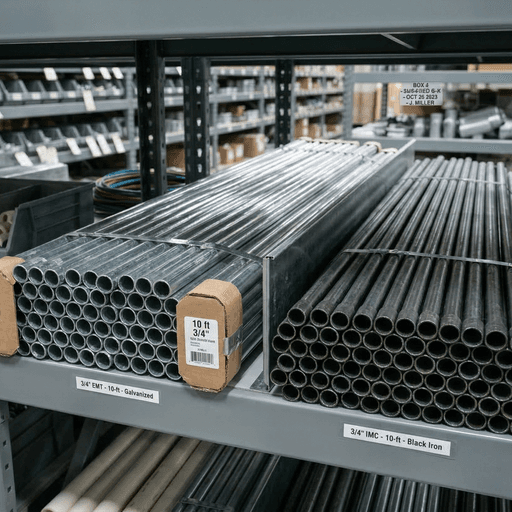
- Article 358: Electrical Metallic Tubing (EMT)
- Article 352: Rigid Polyvinyl Chloride Conduit (PVC)
- Article 344: Rigid Metal Conduit (RMC)
In almost every one of these articles, there is a section labeled “.22 Number of Conductors.” This section invariably points you to Chapter 9 for the actual math.
2. Chapter 9, Table 1 (The Percentage Rule)
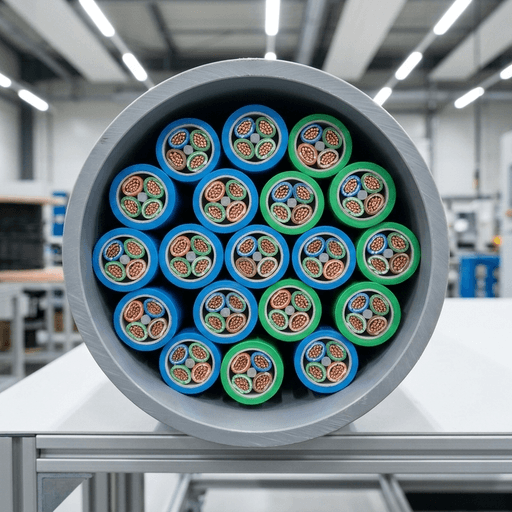
This is the “Headquarters” of conduit fill. Table 1 defines the maximum percentage of a conduit’s area that can be taken up by wires. It applies to all types of conduit and tubing unless you’re working with short “nipples” or specific high-voltage scenarios.
- 1 Conductor: 53%
- 2 Conductors: 31%
- 3 or More Conductors: 40%
Deep Dive: NEC Article 358 (EMT)
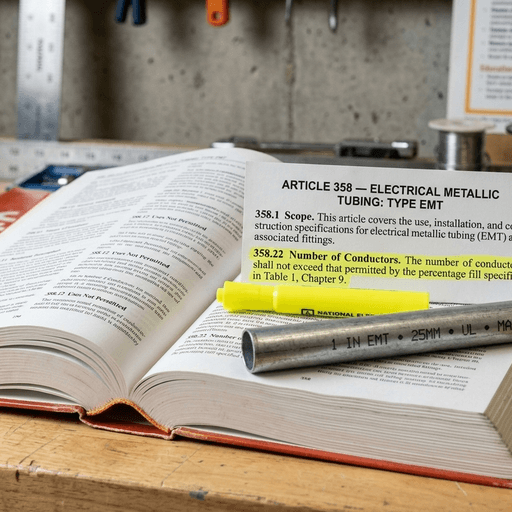
Since EMT is the most widely used conduit, Article 358 is where many electricians start. Section 358.22 simply states: “The number of conductors shall not exceed that permitted by the percentage fill specified in Table 1, Chapter 9.”
It also says that if you’re pulling conductors of the same size and insulation type, you can use the tables in Annex C. This is the NEC’s way of encouraging you to use the pre-calculated charts to avoid math errors in the field.
Chapter 9, Notes to Tables: The Fine Print
Many people skip the “Notes to Tables” in Chapter 9, but this is where the most critical nuances live.
- Note 4 (Conduit Nipples): If your conduit run is 24 inches or less in length (a “nipple”), you are permitted to fill it up to 60% of its total cross-sectional area. This is a common shortcut for mounting panels close together.
- Note 5 (Actual Area vs. Nominal): The NEC requires you to use the actual cross-sectional area of the wire from Table 5, not the “nominal” area.
- Note 9 (Multi-conductor Cables): If you are pulling a single multi-conductor cable (like a tray cable or large data cable), it counts as a single conductor for the 53% rule, even though it contains multiple wires inside its jacket.
The Intersection of Fill and Support (Article 358.30)
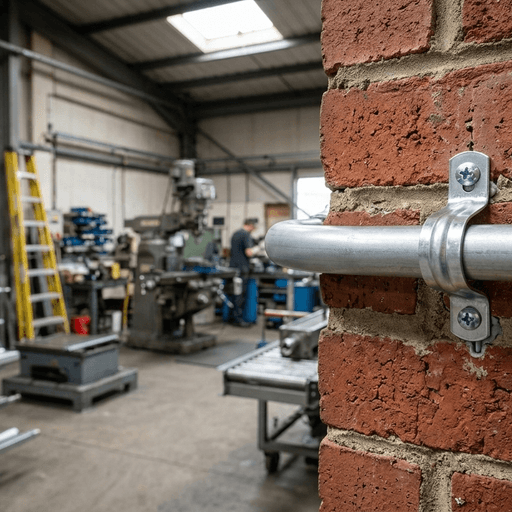
While fill is about the internal space, the NEC also links it to how the conduit is supported. An overfilled conduit is heavy. Article 358.30 requires that EMT be securely fastened within 3 feet of each box or termination and at intervals not exceeding 10 feet.
If you are pushing the 40% fill limit with large conductors, ensure your mounting hardware (like straps and struts) is rated for the combined weight of the pipe and its contents.
When Local Codes Override the NEC
It’s important to remember that the NEC is a “model” code. While most US states adopt it, some local jurisdictions add their own amendments. For example:
- Chicago Bridge Code: Historically has very specific rules for conduit fill that are more restrictive than the base NEC.
- State-Specific Editions: As of 2025, some states are still on the 2017 edition, while others are on 2023. While the 40% rule is constant, the wire diameter tables (Table 5) have significant updates between editions.
Always verify your State’s NEC Adoption Status before final sizing.
Conclusion: Use the Whole Book
Mastering conduit fill means understanding that Article 358 and Chapter 9 are two sides of the same coin. The raceway articles tell you where and how to use the pipe, while Chapter 9 tells you exactly how much you can put inside it.
By following both, you ensure a compliant, safe, and professional electrical system.
Want to stop flipping through the book? Use our NEC Conduit Fill Requirement Tool for instant lookups across Articles 358, 352, and 344 combined.
? Häufig gestellte Fragen
Where in the NEC are conduit fill rules found?
What is NEC Article 358?
What is NEC Chapter 9, Table 1?
Are conduit fill rules the same in all NEC editions?
Does the NEC allow 100% fill for any reason?
Über ซันเดอร์ เค. โอเซอิ
Sander ist ein von der Texas und Georgia zugelassener Bauingenieur (PE), der sich auf Stromverteilersysteme und Einhaltung der Elektrovorschriften für Gewerbebauten spezialisiert hat. Mit einem B.S. in Elektrotechnik von der Georgia Tech und 11 Jahren Beratungs-Erfahrung überprüft er den technischen Inhalt dieser Seite auf Richtigkeit im Vergleich zur neuesten NEC-Auflage. Sander stellt sicher, dass jedes Taschenrechnerergebnis und jede Code-Referenz das widerspiegelt, was Prüfer tatsächlich durchsetzen.