Printable Conduit Sizing Chart: Fill Capacity for EMT, PVC, and IMC (Free PDF)
Download our free 1-page PDF conduit fill cheat sheet. Perfect for electricians and contractors to keep in their work trucks or on their clipboards.

Marcoz T. Webb
Electricista Licenciado & Redactor Técnico

Tabla de contenido
- Why Every Electrician Needs a “Hard Copy” Reference
- 1. Zero Power, Zero Signal
- 2. Multi-Material Comparisons at a Glance
- 3. Documented Field Calculations
- How to Get Your Free PDF Download
- What’s Inside the 1-Page PDF:
- Pro Tips for Making Your Chart Last
- 1. Laminate It IMMEDIATELY
- 2. The Toolbox Clip
- 3. The Truck Dashboard Tape
- How to Read the Chart (Quick Walkthrough)
- Common Mistakes When Using PDF Charts
- Conclusion: The Ultimate Site-Ready Reference
Even in an age of high-tech apps and Digital Conduit Calculators, there’s something to be said for a piece of paper you can hold in your hand. Whether you’re in a “no-phone” industrial facility, a remote basement with zero data, or just want a quick, “no-fuss” lookup on your clipboard, a Printable Conduit Sizing Chart is an essential tool for every electrician.
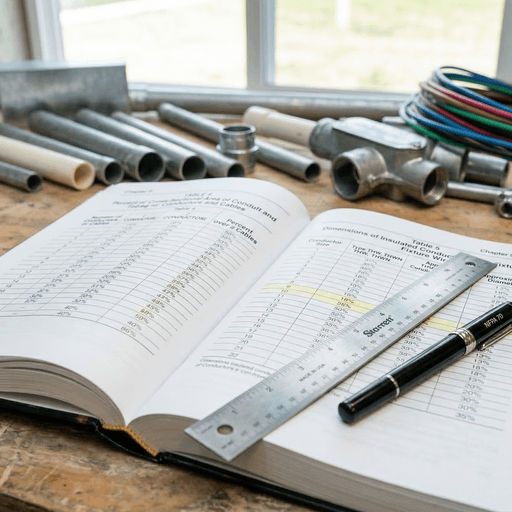
Flip through a 900-page NEC code book once, and you’ll immediately see the value of a single, well-organized page that lists the most common conduit and wire combinations. Our free PDF cheat sheet is designed to be that “secret weapon” that lives in your work truck.
In this guide, we’ll explain how to use our Free Printable Conduit Fill Chart and provide tips for making it a permanent part of your field toolkit.
Why Every Electrician Needs a “Hard Copy” Reference
You might think, “I have an app for that.” But a physical printout offers several advantages that digital tools simply can’t match:
1. Zero Power, Zero Signal
A piece of paper never runs out of battery, and it doesn’t care if you’re in a lead-lined server room or a deep subterranean tunnel. It’s the ultimate “low-tech, high-reliability” tool.
2. Multi-Material Comparisons at a Glance
When you’re looking at an app, you often have to toggle between “EMT” and “PVC” settings. A well-designed chart (like ours) displays them side-by-side, allowing you to instantly see that you might need 3/4-inch PVC if you were planning on 1/2-inch EMT.
3. Documented Field Calculations
Many inspectors appreciate it when you have your reference chart right there on your clipboard. It shows you’re working with a verified standard and makes the sign-off process much smoother.
How to Get Your Free PDF Download
We’ve designed this chart to fit perfectly on a standard 8.5” x 11” piece of paper. You can download the Essential Conduit Sizing PDF Package directly from our site.
What’s Inside the 1-Page PDF:
- EMT (Metalic) Columns: #14 to 4/0 AWG counts.
- PVC Schedule 40 & 80 Columns: Crucial for underground and protective runs.
- IMC/RMC (Rigid) Columns: For heavy-duty industrial work.
- The 40% Compliance Check: Every count in the chart is pre-calculated to stay under the NEC 40% fill limit.
- Ambient Temperature Derating Guide: A small reference table on the bottom for 310.15 adjustments.
Pro Tips for Making Your Chart Last
Don’t just print it on standard office paper and throw it in your truck—it will be unreadable in two days. Here is how the pros handle their printable charts:
1. Laminate It IMMEDIATELY
Spend $2 at an office supply store to laminate your chart. It makes it waterproof, grease-proof, and nearly indestructible. You can also write on it with a dry-erase marker and wipe it clean later.
2. The Toolbox Clip
Many electricians tape their chart to the inside lid of their gang box or the back of their clipboard. This ensures it’s always “handy” but never “in the way.”
3. The Truck Dashboard Tape
If you’re an estimator, tape a copy of the chart to the sun visor of your work truck. You can look up pipe sizes for a quote without ever taking your eyes off the job site.

How to Read the Chart (Quick Walkthrough)
Our chart is organized for Speed Lookup:
- Find your specific Conduit Type on the top horizontal row (e.g., EMT).
- Find your target Trade Size on the left vertical column (e.g., 3/4”).
- Trace the row to your Wire Gauge (e.g., #12 THHN).
- The Number in the Box is your Limit. If you have 16 wires, and the box says “16,” you are at exactly 40% fill.
Warning: If you have mixed wire sizes, do NOT use the chart. You must use a Mixed-Wire Calculator because the chart only calculates for uniform wire counts.
Common Mistakes When Using PDF Charts
- Misreading Insulation Columns: Ensure you are looking at the correct insulation type (THHN vs XHHW).
- Ignoring the Ground: Always count your green ground wire as one of the wires in your count!
- Using an Old Edition: Throw away any charts from before 2020. The 2023 NEC has introduced enough nuances that an old chart could lead to a code violation.
Conclusion: The Ultimate Site-Ready Reference
A printable conduit sizing chart isn’t intended to replace your code book—it’s intended to replace the time you spend flipping through it. By downloading, laminating, and using our free PDF, you gain a high-speed, 100% reliable field tool that will save you time and ensure every job you do is perfectly sized and code-compliant.
Download your copy right now, print it out, and take the first step toward a more professional, organized field kit.
Need the high-resolution version? Click here to Download the Professional 2025 Conduit Fill PDF Package for free.
? Preguntas frecuentes
Is the conduit sizing chart PDF free to download?
Does the PDF include both EMT and PVC?
Is the chart updated for the latest NEC code?
What is the best way to use the printable chart?
Does it cover all wire sizes?
Acerca de Marcoz T. Webb
Marcus es un electricista profesional autorizado con más de 14 años de experiencia en campo en instalaciones eléctricas comerciales e industriales en todo Estados Unidos. Posee una certificación NICET Nivel II en Sistemas Eléctricos y ha trabajado en proyectos que van desde el cableado de oficinas de rascacielos hasta el tendido de conductos de centros de datos. Marcus escribe para cerrar la brecha entre el libro de códigos NEC y las decisiones en el lugar de trabajo.