Which NEC Edition Does Your State Use? Conduit Fill Rules by State (2025)
Learn which NEC edition your state uses. Our guide covers adoption of the 2017, 2020, and 2023 NEC for each state's conduit fill requirements.

Sändar K. Oseji
Eltekniker (PE)
Innehållsförteckning
- The NEC Adoption Cycle: Why the Lag?
- Significant Conduit Fill Changes Between Editions
- NEC 2017 vs. 2020
- NEC 2020 vs. 2023
- Current 2025 Adoption Status (Highlights)
- Why Your Calculator Needs an “Edition” Toggle
- How to Check Your State’s Current Status
- Conclusion: Localization is the Key to Compliance
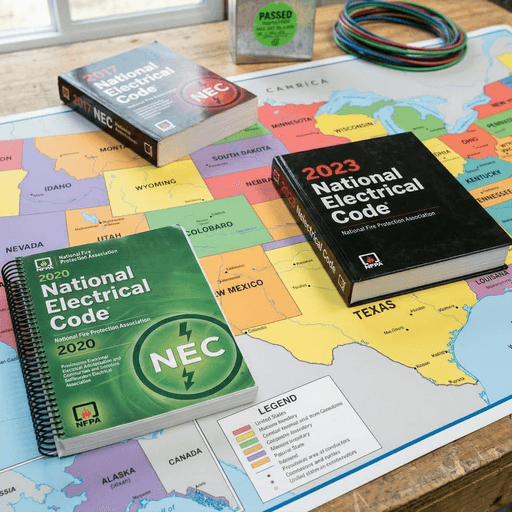
In the United States, the “National” in National Electrical Code (NEC) is a bit of a misnomer. While the NFPA (National Fire Protection Association) authors the code every three years, the NEC is not a federal law. Instead, it is a model code that each state, county, or city must intentionally adopt into their own statutes.
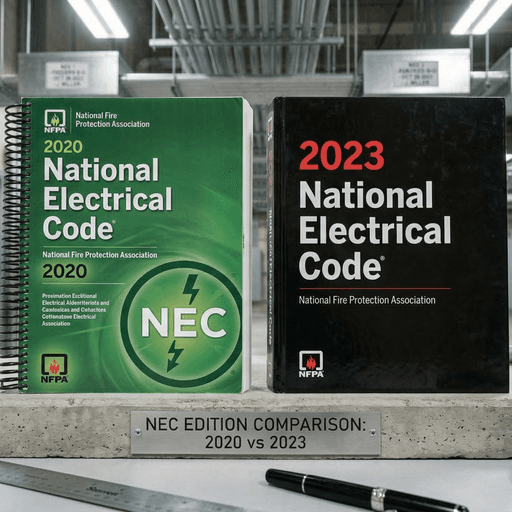
This means that an electrician working in Texas might be using the 2023 NEC, while a contractor just across the border in New Mexico might still be under the 2020 or even 2017 edition. For conduit fill calculations, this variation matters more than you might think.
In this 2025 guide, we’ll explain the current landscape of NEC adoption in the US and how to ensure your conduit fill calculations are legal for the specific jurisdiction where you’re holding a permit.
The NEC Adoption Cycle: Why the Lag?
The NFPA releases a new NEC edition every three years (2017, 2020, 2023, 2026). However, the adoption process is slow:
- The NFPA Publishes: The code is finalized.
- The “Review” Period: States and cities form committees to read the new code and identify sections they want to amend or cut.
- The Legislative Process: The state legislature must vote to adopt the new edition into law.
- The Effective Date: There is usually a grace period of 6–12 months before the new rules are officially enforced by inspectors.
Significant Conduit Fill Changes Between Editions
While the core 40% fill rule has been the standard for decades, the details shift between editions:
NEC 2017 vs. 2020
- Wire Table Updates: Some wire manufacturers updated their standard insulation thicknesses, leading to small but important changes in Chapter 9, Table 5.
- Compact Conductors: The 2020 code provided more clarity on the space requirements for compact stranded aluminum conductors, which are becoming the standard for large feeders.
NEC 2020 vs. 2023
- Medium Voltage Rules: Major updates to how high-voltage industrial conduit is sized.
- GFCI Expansion: While not a “fill” rule, the 2023 expansion of GFCI requirements often leads to more multi-wire branch circuits sharing a single conduit, which triggers the higher ampacity derating rules.
Current 2025 Adoption Status (Highlights)
Note: Adoption is dynamic. Always verify with your local AHJ (Authority Having Jurisdiction).
- The “2023 Leaders”: States like Texas, Florida, Minnesota, and Washington are typically fast adopters and are already enforcing the 2023 NEC.
- The “2020 Majority”: Large states like California, New York, and Pennsylvania often move on a slower cycle and are largely on the 2020 edition (sometimes with massive state-specific amendments).
- The “2017 Holdouts”: A handful of states and many rural counties still use the 2017 NEC as their legal baseline.
Why Your Calculator Needs an “Edition” Toggle
Because of these state differences, a “one-size-fits-all” calculator can be dangerous. A calculation that is perfectly compliant on the 2017 NEC in New Mexico might technically be a violation on the 2023 NEC in Texas.
When you use our NEC Adopton-Aware Calculator, you can choose the specific NEC edition (2017, 2020, or 2023) to ensure your fill schedule matches exactly what the local inspector’s book says.
How to Check Your State’s Current Status
- NFPA.org: They maintain an official (though occasionally delayed) map of state-wide adoption.
- NEMA: The National Electrical Manufacturers Association provides detailed reports on which states have adopted the latest technology-related code updates.
- Your Local Building Department: If you’re pulling a permit in a specific city, their website will invariably list the “Codes in Effect.” This is the only 100% reliable source.
Conclusion: Localization is the Key to Compliance
For a modern electrician, knowing “the code” is only half the battle. You must also know which version of the code you’re working under today. By understanding the adoption landscape in 2025 and adjusting your conduit sizing math accordingly, you protect your company from rework and ensure a smoother relationship with your local inspectors.
Stay current, stay flexible, and always check your local edition before you bend your first piece of pipe.
Moving Between States? Use our Multi-Edition NEC Conduit Tool to instantly bridge the gap between 2017, 2020, and 2023 compliance.
? Vanliga Frågor
Does every state use the same version of the NEC?
What is the newest edition of the NEC?
Why does it matter if my state is on the 2017 vs. 2023 NEC?
Is California on the 2023 NEC?
How can I find my local electrical code edition?
Om Sändar K. Oseji
Sander är en Civilingenjör (PE) licensierad i Texas och Georgia, specialiserad på eldistributionssystem och elektrisk efterlevnad av byggregler för kommersiell konstruktion. Med en kandidatexamen i Elektroteknik från Georgia Tech och 11 års konsultationserfarenhet granskar han teknisk innehåll på denna webbplats för noggrannhet mot den senaste NEC-utgåvan. Sander säkerställer att alla beräkningsresultat och kodreferenser återspeglar vad inspektörer faktiskt föreskriver.