Wire Cross-Sectional Area Reference: AWG Sizes, OD, and Area for THHN, XHHW, and More
Accurate conduit fill calculations start with accurate wire dimensions. This reference table covers OD and cross-sectional area for the most common wire types used in conduit runs.

Sander K. Osei
Electrical Engineer (PE)
If you’re an electrician or electrical contractor, your work is a numbers game. You don’t just “guess” if a wire fits; you measure. And the most important measurement in any conduit calculation is the wire cross-sectional area.
Getting the area wrong by just a fraction of a square inch can be the difference between a project that is code-compliant and one that fails an inspection. In this guide, we provide a complete reference chart for the most common AWG (American Wire Gauge) sizes and their associated areas for THHN, XHHW, and other standard insulation types.
The Difference Between Gauge and Area
One of the most common misconceptions for apprentices is that “AWG” is a direct measurement of the wire’s physical thickness inside a conduit. It’s not.
- AWG (Gauge): Refers only to the thickness of the conductor material (copper or aluminum).
- Cross-Sectional Area: Refers to the total occupied space of the conductor plus its insulation.
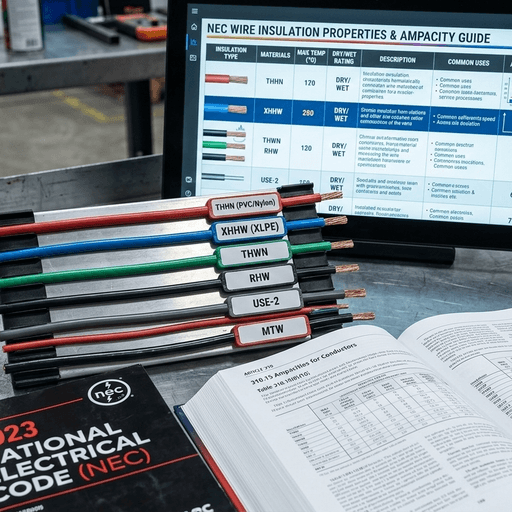
For example, a #10 THHN wire and a #10 XHHW wire both have the same amount of copper (#10 AWG). However, because XHHW insulation is thicker, it has a larger cross-sectional area and will fill up a conduit much faster.
THHN / THWN-2 Wire Area Chart (NEC Table 5)
The most common wire used in dry commercial locations is THHN (Thermoplastic High Heat-resistant Nylon-coated). It is popular precisely because its insulation is relatively thin, allowing for more wires in a given conduit.
| AWG Size | Outer Diameter (inch) | Cross-Sectional Area (sq. in.) |
|---|---|---|
| #14 | 0.111 | 0.0097 |
| #12 | 0.130 | 0.0133 |
| #10 | 0.164 | 0.0211 |
| #8 | 0.216 | 0.0366 |
| #6 | 0.254 | 0.0507 |
| #4 | 0.324 | 0.0824 |
XHHW / XHHW-2 Wire Area Chart
XHHW (Cross-linked Polyethylene High Heat-resistant Water-resistant) is common in wet or damp locations. It is thicker and more rugged than THHN.
| AWG Size | Outer Diameter (inch) | Cross-Sectional Area (sq. in.) |
|---|---|---|
| #14 | 0.133 | 0.0139 |
| #12 | 0.152 | 0.0181 |
| #10 | 0.176 | 0.0243 |
| #8 | 0.236 | 0.0437 |
| #6 | 0.274 | 0.0590 |
| #4 | 0.322 | 0.0814 |
Interesting Note: Notice that for #12 wires, XHHW (0.0181) is nearly 35% larger than THHN (0.0133). If you don’t adjust your conduit size calculation for these different insulations, you’ll be significantly overfilled.
How to Calculate Area Yourself (For Specialty Cables)
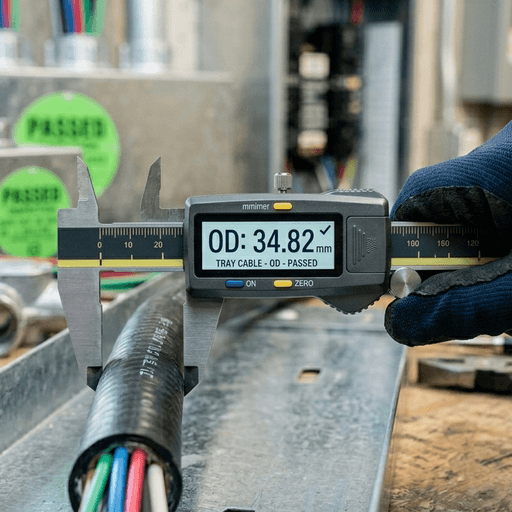
What if you’re pulling a specialty shielded data cable or a tray cable that isn’t in Table 5? You must use the manufacturer’s spec sheet to find the Outer Diameter (OD) and then use the formula for the area of a circle.
The Diameter-to-Area Formula:
Area = 0.7854 × Diameter²
Example: Suppose you have a specialty cable with an OD of 0.25 inches.
- Area = 0.7854 x (0.25 x 0.25)
- Area = 0.7854 x 0.0625 = 0.0491 sq. in.
This is roughly the same as a #6 THHN wire.
Why Decimal Precision Matters
In conduit fill math, every decimal point counts. For example, the difference between a 39.5% fill and a 40.5% fill is just 1%. But that 1% is the difference between a job that is code-compliant and one that is not.
While some old-school electricians try to “eye-ball” their wire counts, a professional always relies on the NEC Chapter 9, Table 5 values. This ensures that their work is mathematically sound and universally defensible to inspectors and engineers.
Conclusion: The Backbone of Accuracy
Accurate wire cross-sectional area data is the foundation of a successful conduit run. By understanding the difference between Gauge and Area, and using the correct reference charts for your specific insulation type, you eliminate the guesswork from your life-safety electrical installations.
Don’t settle for “close enough.” Use the exact numbers, fill your conduits legally, and always do the job right the first time.
Need a faster way to look up these areas? Use our Digital Wire Cross-Sectional Area Chart for instant results across all AWG sizes and insulation materials.
? Frequently Asked Questions
What is the cross-sectional area of a wire?
Is the cross-sectional area only for copper?
How does wire insulation affect the area?
What is OD in a wire chart?
Do aluminum wires have the same area as copper?
About Sander K. Osei
Sander is a Professional Engineer (PE) licensed in Texas and Georgia, specializing in power distribution systems and electrical code compliance for commercial construction. With a B.S. in Electrical Engineering from Georgia Tech and 11 years of consulting experience, He reviews technical content on this site for accuracy against the latest NEC edition. Sander ensures every calculator result and code reference reflects what inspectors actually enforce.