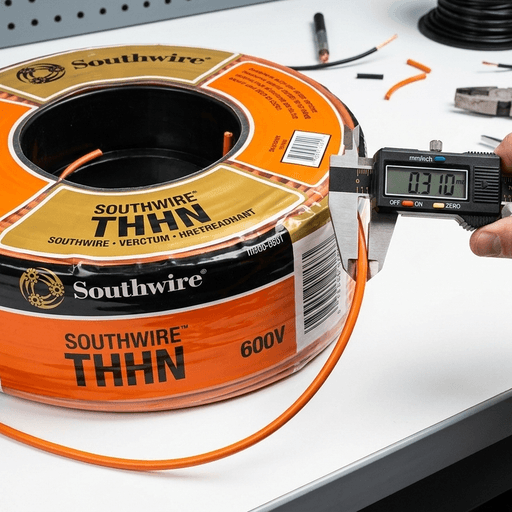
Graphique de la section transversale des câbles
Trouvez un tableau de référence complet des aires d'intersection des fils. Comparez les tailles AWG, le diamètre extérieur (OD) et l'aire pour les types de conducteurs THHN, XHHW et autres courants.

Sандër K. Oзэй
Ingénieur Électrique (PE)
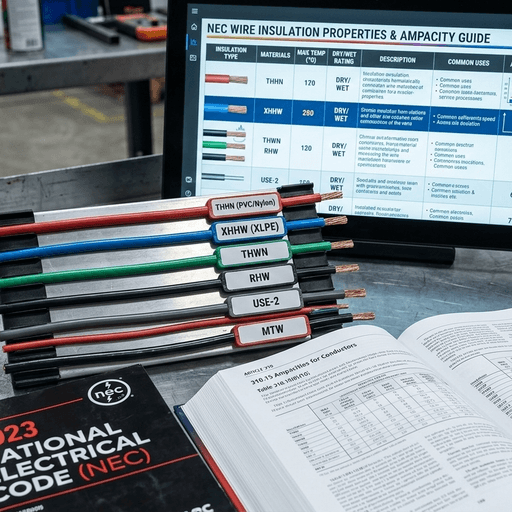
Table des matières
Obtenir la surface incorrecte d'à peine une fraction de pouce carré peut faire la différence entre un projet conforme aux normes et un qui échoue à un contrôle. Dans ce guide, nous fournissons un tableau de référence complet pour les tailles AWG (American Wire Gauge) les plus courantes et leurs surfaces associées pour THHN, XHHW et autres types d'isolation standard.
La différence entre l'échelle et la surface
L’une des plus fréquentes erreurs pour les apprentis est qu’ « AWG » est une mesure directe d’épaisseur physique du fil à l’intérieur d’un conduit. Ce n’est pas le cas.
- AWG (Gauge): Fait référence uniquement à l'épaisseur du matériau du conducteur (cuivre ou aluminium).
- Aire de section: Fait référence à l’espace total occupé du conducteur plus son isolation.
THHN / THWN-2 Wire Area Chart (NEC Table 5)
Le fil le plus couramment utilisé dans les locaux commerciaux secs est THHN (Thermoplastic High Heat-resistant Nylon-coated). Il est populaire précisément parce que son isolation est relativement fine, permettant d'avoir plus de fils dans un même conduit.
AWG Size
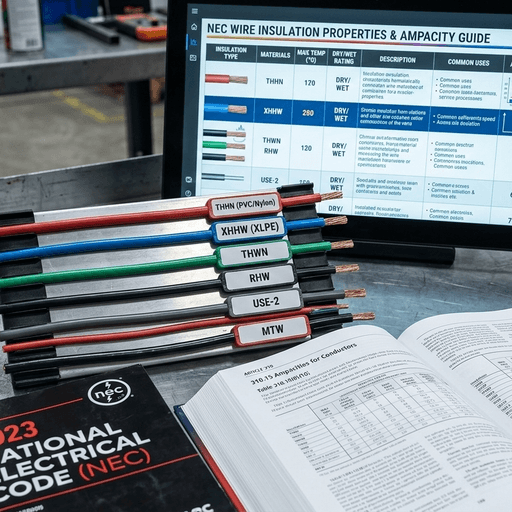
XHHW / XHHW-2 Wire Area Chart
XHHW (Cross-linked Polyethylene High Heat-resistant Water-resistant) est couramment utilisé dans les endroits humides ou humides. Il est plus épais et plus robuste que le THHN.
AWG Size
Note intéressante : Remarquez que pour les câbles #12, XHHW (0.0181) est presque 35% plus grand que THHN (0.0133). Si vous ne faites pas correctement l’ajustement de votre taille de tuyau pour ces différents isolants, vous serez significativement surchargé.
Comment calculer l'aire vous-même (Pour les câbles spéciaux)
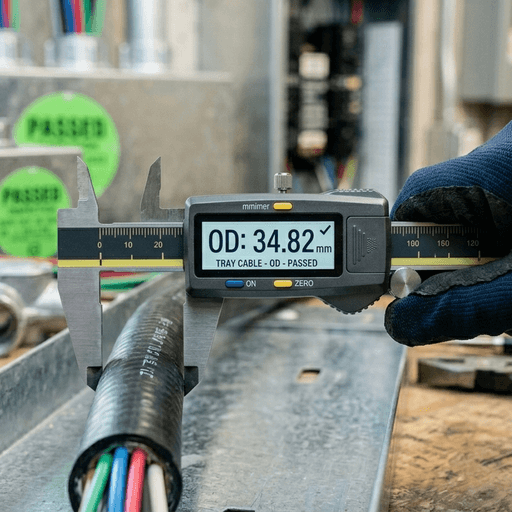
Qu'advient-il si vous tirez un câble de données blindé spécialisé ou un câble de cassette qui n'est pas dans le Tableau 5 ? Vous devez utiliser la fiche technique du fabricant pour trouver le Diamètre Extérieur (DE) et ensuite utiliser la formule pour l'aire d'un cercle.
Le formule Diamètre-à-Aire :
Aire = 0.7854 × Diamètre²
Exemple :
Supposons que vous avez un câble spécialisé avec un diamètre extérieur de 0,25 pouces.
- Surface = 0.7854 x (0.25 x 0.25)
- Surface = 0.7854 x 0.0625 = 0.0491 sq. in.
Pourquoi la précision décimale compte
Dans les calculs de remplissage en conduits, chaque virgule décimale compte. Par exemple, la différence entre un remplissage de 39,5 % et un remplissage de 40,5 % n'est que de 1 %. Mais cette 1 % est la différence entre un travail conforme aux normes et un travail qui ne l’est pas.
Bien que certains électriciens traditionnels essaient de "deviner" le nombre de leurs fils, un professionnel s'appuie toujours sur les valeurs du chapitre 9, tableau 5 du NEC. Cela garantit que leur travail est mathématiquement solide et universellement défendable auprès des inspecteurs et des ingénieurs.
Conclusion : Le pilier de la précision
Les données précises sur la surface de section des fils sont la base d'une installation de gaine de conduit réussie. En comprenant la différence entre le calibre et la surface, et en utilisant les bons tableaux de référence pour votre type d'isolation spécifique, vous éliminez les suppositions de votre vie et de vos installations électriques liées à la sécurité.
Ne vous contentez pas de « suffisamment proche ». Utilisez les chiffres exacts, remplissez vos conduits légalement et faites toujours le travail correctement la première fois.
Besoin d'un moyen plus rapide de consulter ces zones ? Utilisez notre Digital Wire Cross-Sectional Area Chart pour obtenir des résultats instantanés pour toutes les tailles de fil et tous les matériaux d'isolation.
? Questions fréquemment posées
Quelle est la surface d'une section de fil ?
La surface d'une section de fil ne concerne-t-elle que le cuivre ?
Comment l'isolation d'un fil affecte-t-elle la surface ?
Que signifie OD sur un tableau de fils ?
Les fils en aluminium ont-ils la même surface que les fils en cuivre ?
À propos Sандër K. Oзэй
Sander est un Ingénieur Professionnel (IP) agréé au Texas et en Géorgie, spécialisé dans les systèmes de distribution d'énergie et la conformité aux codes électriques pour la construction commerciale. Il est titulaire d'un B.S. en Génie Électrique de Georgia Tech et possède 11 années d'expérience en conseil. Il examine le contenu technique sur ce site pour vérifier son exactitude par rapport à la dernière édition du NEC. Sander veille à ce que chaque résultat de calculleur et chaque référence au code reflètent ce que les inspecteurs appliquent réellement.