電線管占有率計算機 ロゴ
電線管占有率計算機
📐 コンジット充填マニュアル 2026年4月17日

Wire Cross-Sectional Area Reference: AWG Sizes, OD, and Area for THHN, XHHW, and More

Find a complete reference chart for wire cross-sectional areas. Compare AWG sizes, OD, and area for THHN, XHHW, and other common conductor types.

サンダー・オーサイ

サンダー・オーサイ

電気技術者(専門技術者)

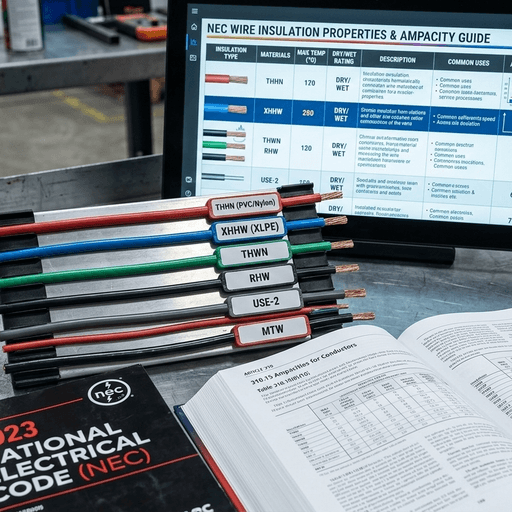
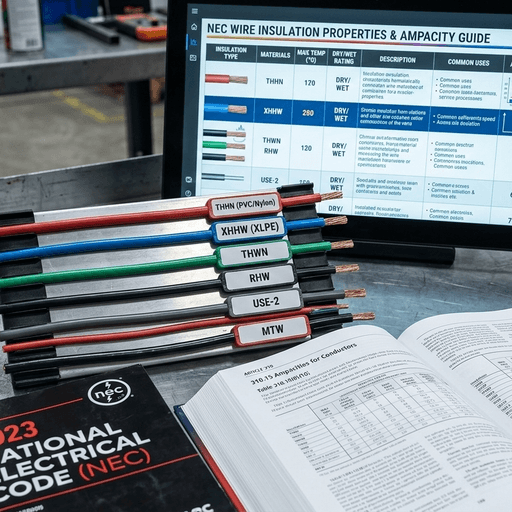
さまざまな種類のワイヤー被覆(THHN、XHHW)とNEC規格書
注記: 情報は教育目的です。

If you’re an electrician or electrical contractor, your work is a numbers game. You don’t just “guess” if a wire fits; you measure. And the most important measurement in any conduit calculation is the wire cross-sectional area.

Getting the area wrong by just a fraction of a square inch can be the difference between a project that is code-compliant and one that fails an inspection. In this guide, we provide a complete reference chart for the most common AWG (American Wire Gauge) sizes and their associated areas for THHN, XHHW, and other standard insulation types.

The Difference Between Gauge and Area

One of the most common misconceptions for apprentices is that “AWG” is a direct measurement of the wire’s physical thickness inside a conduit. It’s not.

  • AWG (Gauge): Refers only to the thickness of the conductor material (copper or aluminum).
  • Cross-Sectional Area: Refers to the total occupied space of the conductor plus its insulation.

For example, a #10 THHN wire and a #10 XHHW wire both have the same amount of copper (#10 AWG). However, because XHHW insulation is thicker, it has a larger cross-sectional area and will fill up a conduit much faster.

THHN / THWN-2 Wire Area Chart (NEC Table 5)

The most common wire used in dry commercial locations is THHN (Thermoplastic High Heat-resistant Nylon-coated). It is popular precisely because its insulation is relatively thin, allowing for more wires in a given conduit.

AWG SizeOuter Diameter (inch)Cross-Sectional Area (sq. in.)
#140.1110.0097
#120.1300.0133
#100.1640.0211
#80.2160.0366
#60.2540.0507
#40.3240.0824

Different types of wire insulation (THHN, XHHW) with NEC book

XHHW / XHHW-2 Wire Area Chart

XHHW (Cross-linked Polyethylene High Heat-resistant Water-resistant) is common in wet or damp locations. It is thicker and more rugged than THHN.

AWG SizeOuter Diameter (inch)Cross-Sectional Area (sq. in.)
#140.1330.0139
#120.1520.0181
#100.1760.0243
#80.2360.0437
#60.2740.0590
#40.3220.0814

Interesting Note: Notice that for #12 wires, XHHW (0.0181) is nearly 35% larger than THHN (0.0133). If you don’t adjust your conduit size calculation for these different insulations, you’ll be significantly overfilled.

How to Calculate Area Yourself (For Specialty Cables)

What if you’re pulling a specialty shielded data cable or a tray cable that isn’t in Table 5? You must use the manufacturer’s spec sheet to find the Outer Diameter (OD) and then use the formula for the area of a circle.

The Diameter-to-Area Formula:

Area = 0.7854 × Diameter²

Example: Suppose you have a specialty cable with an OD of 0.25 inches.

  • Area = 0.7854 x (0.25 x 0.25)
  • Area = 0.7854 x 0.0625 = 0.0491 sq. in.
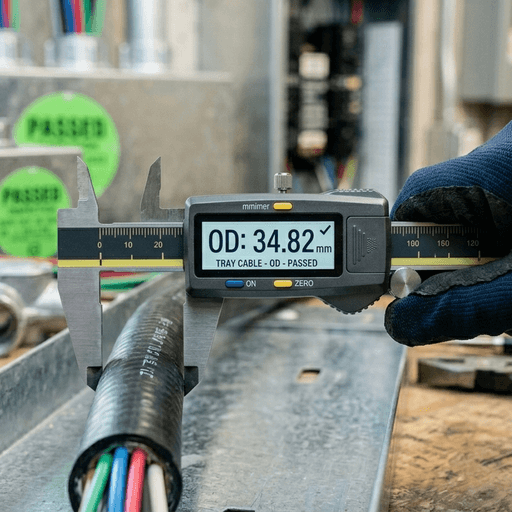
This is roughly the same as a #6 THHN wire.

Digital calliper measuring tray cable outer diameter

Why Decimal Precision Matters

In conduit fill math, every decimal point counts. For example, the difference between a 39.5% fill and a 40.5% fill is just 1%. But that 1% is the difference between a job that is code-compliant and one that is not.

While some old-school electricians try to “eye-ball” their wire counts, a professional always relies on the NEC Chapter 9, Table 5 values. This ensures that their work is mathematically sound and universally defensible to inspectors and engineers.

Conclusion: The Backbone of Accuracy

Accurate wire cross-sectional area data is the foundation of a successful conduit run. By understanding the difference between Gauge and Area, and using the correct reference charts for your specific insulation type, you eliminate the guesswork from your life-safety electrical installations.

Don’t settle for “close enough.” Use the exact numbers, fill your conduits legally, and always do the job right the first time.

Need a faster way to look up these areas? Use our Digital Wire Cross-Sectional Area Chart for instant results across all AWG sizes and insulation materials.

? よくある質問

What is the cross-sectional area of a wire?
The cross-sectional area of a wire is the total space it occupies inside a conduit. It is calculated by taking the square of half its diameter (radius) multiplied by pi (π).
Is the cross-sectional area only for copper?
No, when calculating conduit fill, the cross-sectional area includes both the actual electrical conductor (copper or aluminum) AND the surrounding insulation (PVC, nylon, etc.).
How does wire insulation affect the area?
Wire insulation significantly changes the overall diameter of the wire. For example, a #12 wire with THHN insulation (thin-wall) is much smaller than a #12 wire with XHHW (thicker wall) or RHW (very thick wall) insulation.
What is OD in a wire chart?
OD stands for Outer Diameter. It is the measurement from one outside edge of the wire insulation to the other, passing through the center of the conductor.
Do aluminum wires have the same area as copper?
Technically, the AWG sizes refer to the same conductor diameter, but since aluminum is less conductive, you often have to use a larger AWG size to carry the same current. This increases your conduit fill requirements.
サンダー・オーサイ

概要 サンダー・オーサイ

サンダーは、テキサス州とジョージア州で専門エンジニア(PE)の資格を持ち、商業建築における電力配電システムと電気工事規程の遵守を専門としています。ジョージア工科大学で電気工学の学士号を取得し、11年のコンサルティング経験を持つ彼は、このサイトの技術コンテンツの正確性を最新のNEC(電気工事規程)版と照合するためにレビューを行います。サンダーは、すべての電卓の結果とコード参照が、検査官が実際に適用している内容を反映するように保証しています。